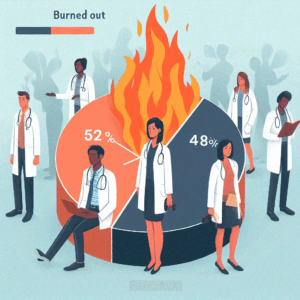

The EHR, “Pajama time,” and physician burnout
In this article we explore the impact of “pajama time” and physician burnout, and propose radical solutions like: stop working at home.

In this article we explore the impact of “pajama time” and physician burnout, and propose radical solutions like: stop working at home.

In the often grueling world of medicine, physicians are revered as invincible healers—pillars of strength, wisdom, and resilience. We bear the immense responsibility of safeguarding the health and lives of others. But behind the white coats and professional facades, doctors are human too, grappling with the same vulnerabilities as anyone else.

Social connection is good for us. Loss of social connection is a major causative factor in physician burnout. In this article we explore social connection for physician burnout, offering a number of suggestions to reach out and connect for your own wellbeing.

“We lost him”. The surgical resident whispered it under his breath, stepping away from the trauma bay. The blood on his gloves and scrubs, a dull reddish brown under fluorescent lights, told the story of a 12-hour shift spent fighting battles he often lost.

We all talk about the importance of letting go, but they are very few of us that can actually do it well. Perhaps being human makes it so hard.
Yet it is when we let go that things begin to move and what we’ve been hoping and wishing for comes in alignment.

One of the biggest lessons I’ve learned on my Hero’s Journey is the importance of learning to accept ourselves (our full selves).

In a world that constantly demands excellence, where the pursuit of perfection is the norm, there lies a secret joy hidden in the unlikeliest of places – the realm of mediocrity in medicine.

Bullying in medicine is a pervasive issue that has far-reaching consequences for healthcare trainees and professionals and, ultimately, patient care.

How an obsession with success can lead to physician burnout; and strategies for mitigation

Why do we need laws? After all, hospitals and healthcare businesses know all about the corporate risks of overwork! We argue that without legislation to force safety, nothing will change because little, if anything, has changed to protect healthcare staff from overwork.

I have so many regrets about my medical career that I don’t even know where to begin. And I am not alone. We all make mistakes, give suboptimal service, have off days, or (most often, in my experience), nature wins. The cancer progresses. The psychosis relapses. The diabetes complicates. So am I going to wallow in them and feel sorry for myself? Or is there another way of dealing with regrets in my career as a doctor?

For so many reasons the term “disruptive doctor” is unhelpful at best, cruel and discriminatory at worst. As a label it has been used and misused. Very few physicians start out disruptive. The reality is that disruptive behavior in physicians is often a symptom of a larger systemic problem. It may be related to stress, burnout, mental health issues, addiction, and more.

As healthcare in many countries evolves into a profit-driven industry, physicians face increasing pressures to prioritize efficiency, productivity, and financial outcomes over patient care and personal well-being.

Addressing physician wellbeing is a complex challenge that requires a comprehensive approach beyond individual interventions. A physician well-being ecosystem, designed to support and prioritize the mental and emotional well-being of physicians, is crucial for sustainable change.

This powerful positive affirmation masterpiece will help you achieve inner peace, forgiveness, acceptance, good physical and mental health, success, abundance, wealth, and harmony.

My journey through the dark night of the soul as a physician was profound and transformative. It challenged my identity, purpose, and resilience, leading to a deep exploration of myself.

Positive affirmations are a powerful tool that can help you fight burnout. If you are feeling overwhelmed by stress, try using positive affirmations to boost your self-confidence and self-esteem. With a little practice, you can start to see a difference in your mood, emotions, and overall well-being.

In this article we explore the concept of the dark night of the medical soul, its characteristics, and the resultant opportunities for growth.

This is part one of a guest blog by one of our senior mentors. She was a groundbreaker as a woman of color studying medicine in the 1970s. Here, she recounts her struggles in Pre-Med.

This is part two of a guest blog by one of our senior mentors. She was a groundbreaker as a woman of color studying medicine in the 1970s. Here, she recounts her first year at Med School far from home.

Before you started studying / working in medicine, how many hours of sleep did you get a night (on average)? What happened to your sleep during med school, residency, and beyond? Sleep, and the lack thereof, is so tied up in our working hours and such a tradition in medicine, that we almost take the lack of it for granted.